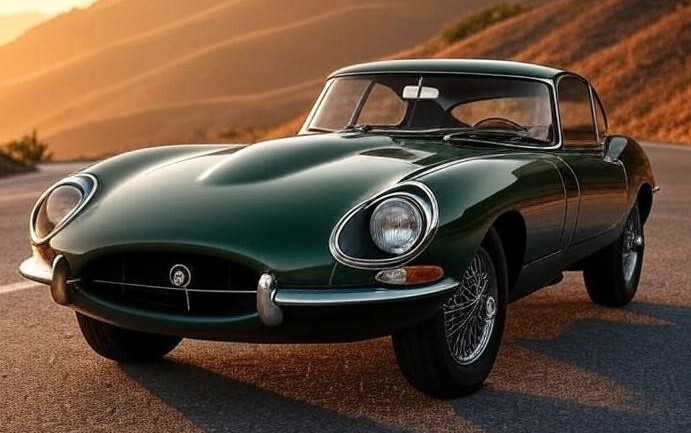
When people think of legendary sports cars, one name often takes the spotlight—the Jaguar E-Type (1961). This British masterpiece wasn’t just another car; it was a bold statement in automotive history. Enzo Ferrari, the founder of Ferrari himself, once called it “the most beautiful car ever made.” That’s no small praise.
But what exactly made this car so extraordinary? The Jaguar E-Type didn’t just win hearts with its jaw-dropping design; it also redefined what sports cars could be. In the early 1960s, high-performance cars were mostly reserved for the wealthy elite. Jaguar, however, offered a machine that combined the speed of a Ferrari, the elegance of an Aston Martin, and the price point of a luxury sedan. This unique blend made the Jaguar E-Type (1961) a true people’s sports car.
The E-Type’s arrival in 1961 marked a turning point in automotive history. It symbolized freedom, youth, and innovation—perfectly aligning with the cultural wave of the swinging sixties. Today, over six decades later, it still commands admiration not just as a collector’s item but as a timeless design benchmark. Designers, engineers, and enthusiasts continue to reference it as one of the purest expressions of automotive art ever created.
In this blog, we’ll dive deep into its history, design, engineering, cultural impact, driving experience, and legacy. By the end, you’ll understand why the Jaguar Jaguar E-Type (1961) remains one of the greatest sports cars ever created—and why it continues to inspire car lovers and designers alike.
The Birth of the Jaguar E-Type (1961)
How It All Started
The 1950s and early 1960s were an exciting time for the automobile industry. Jaguar had already earned a reputation for producing beautiful and successful racing cars like the Jaguar D-Type, which won multiple 24 Hours of Le Mans races. The company wanted to bring that racing DNA to the everyday driver without sacrificing comfort and usability.
Jaguar’s founder, Sir William Lyons, believed performance and beauty should go hand in hand. The engineering brilliance behind the E-Type was largely credited to Malcolm Sayer, an aerodynamicist who applied aircraft design principles to car development. His scientific approach to shaping the body resulted in curves that were not only beautiful but also highly functional.
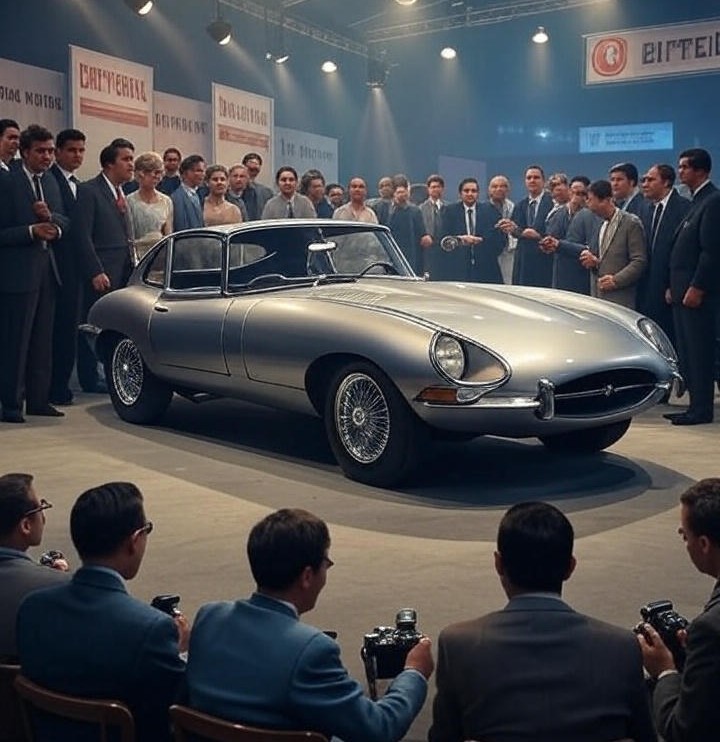
In March 1961, at the Geneva Motor Show, Jaguar unveiled the Jaguar E-Type. It stunned everyone—not just because of its sleek looks, but also because of its performance. Journalists, buyers, and rival carmakers gathered around to see this new creation that blended luxury, speed, and affordability. The demand was so overwhelming that Jaguar had to rush additional cars overnight to Switzerland just to satisfy media test drives.
Why 1961 Was Special
- It was the year the Jaguar E-Type made its public debut, marking the start of a new era in sports cars.
- It combined racing-inspired aerodynamics with an elegant road-car design.
- Unlike Ferraris or Aston Martins, the E-Type was relatively affordable, making it accessible to a wider audience.
- It demonstrated that cutting-edge engineering didn’t have to come with an ultra-exclusive price tag.
Design: Beauty That Made History
Aerodynamic Perfection
The Jaguar E-Type (1961) was inspired directly by the aerodynamic principles of the D-Type racer. Its long bonnet, rounded curves, and low stance weren’t just stylish—they improved airflow and stability at high speeds.
Key design highlights:
- Long hood and short rear deck – giving it a powerful, predatory stance.
- Covered headlights – blending seamlessly into the body for a futuristic and clean look (on early Series 1 models).
- Oval front air intake – simple yet aggressive, feeding cool air to the engine.
- Slim chrome bumpers – minimal and elegant, preserving the purity of the lines.
- Wire-spoke wheels – adding a classic motorsport character.
The proportions were near perfect. Even when parked, the E-Type looked like it was in motion. Its flowing lines created a sense of speed and grace that very few cars—then or now—can replicate.
Inside the Cabin
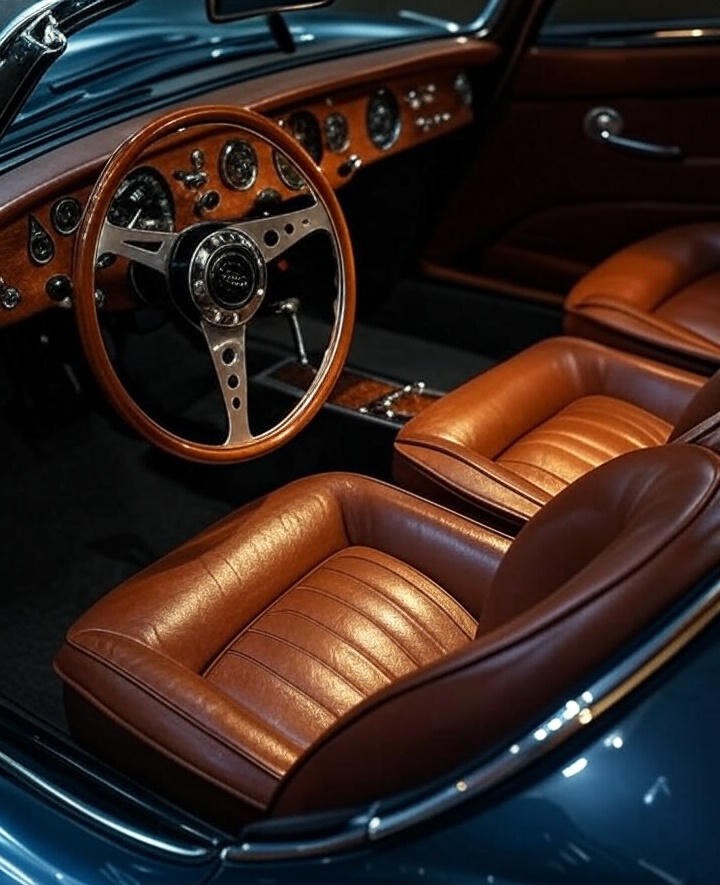
The interior was as luxurious as the exterior was dramatic, but it was also driver-focused.
- Leather bucket seats with firm lateral support.
- Polished wooden steering wheel that felt both vintage and sporty.
- A dashboard filled with aircraft-inspired gauges and toggle switches.
- A center console angled slightly toward the driver.
- Minimal insulation, allowing the driver to feel connected to the engine and road.
Unlike many modern sports cars filled with screens and digital interfaces, the E-Type delivered a raw, mechanical experience. You didn’t just drive it—you interacted with it.
Comparisons With Rivals
At the time of its launch, the Jaguar E-Type entered a competitive arena dominated by prestigious European sports cars. Ferrari had models like the Ferrari 250 GT, while Aston Martin offered the elegant Aston Martin DB4. Both were stunning machines with strong racing pedigree—but they came at a significantly higher price.
The E-Type disrupted this segment by delivering comparable performance figures at nearly half the cost. In many cases, buyers could purchase an E-Type and still have money left compared to buying a Ferrari. This wasn’t just competitive—it was revolutionary. Jaguar effectively democratized high-performance motoring without compromising prestige.
Performance-wise, the E-Type could match or even outperform some rivals in top speed tests. Its 150 mph capability placed it in true supercar territory for the era. Meanwhile, its independent rear suspension gave it a smoother ride than many competitors, which often relied on more traditional rear axle setups.
Another area where Jaguar stood out was design purity. While Ferraris often carried ornate detailing and Aston Martins leaned toward refined British understatement, the Jaguar E-Type combined sensual curves with race-inspired minimalism. It looked exotic without trying too hard.
In short, Jaguar didn’t just compete with Ferrari and Aston Martin—it forced them to reconsider how much performance and beauty should cost.
Engineering Excellence of the Jaguar E-Type (1961)
Performance That Shocked the World
The Jaguar E-Type wasn’t just about looks—it had the power to back it up.
- Engine: 3.8-liter inline-six producing 265 horsepower.
- Top Speed: Around 150 mph (240 km/h).
- 0–60 mph: In under 7 seconds—astonishing for the 1960s.
- Transmission: 4-speed manual gearbox delivering engaging shifts.
At a time when many sports cars struggled to cross 130 mph, the E-Type comfortably touched 150 mph, placing it among the fastest production cars in the world.
Innovations Ahead of Its Time
The car introduced features that were revolutionary for the early ’60s:
- Independent rear suspension – improving both handling and ride comfort.
- Disc brakes on all four wheels – providing superior stopping power.
- Monocoque construction – stronger yet lighter body design.
- Rack-and-pinion steering – offering more precise control.
These innovations made the Jaguar E-Type (1961) a performance benchmark and a car that felt decades ahead of its competitors. Even today, its engineering layout is admired for its balance and sophistication.
Driving Experience: What It Felt Like on the Road
Driving the Jaguar E-Type (1961) was—and still is—a sensory event. The moment you turn the key, the inline-six engine awakens with a metallic growl that instantly reminds you this is no ordinary car. There’s a raw mechanical honesty to the sound, especially when revved beyond 4,000 rpm.
The long bonnet stretching ahead gives the driver a dramatic cockpit-like view. It creates a sense of occasion every time you sit behind the wheel. Unlike modern sports cars that isolate you from the road, the E-Type keeps you fully connected. You feel the vibration through the steering wheel, the subtle feedback from the suspension, and even the texture of the pavement beneath the tires.
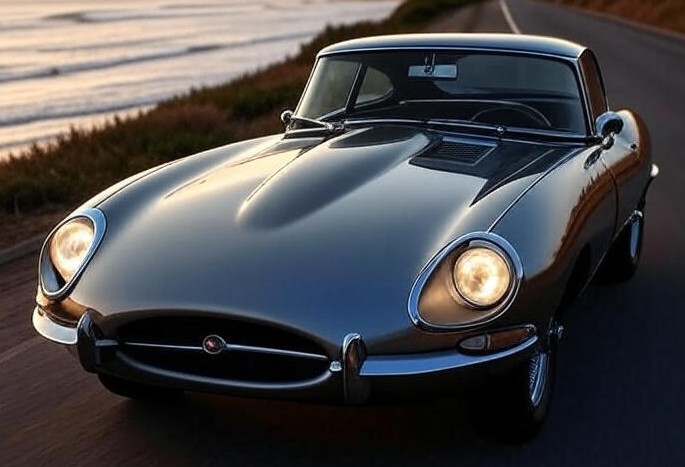
On winding roads, the independent rear suspension truly shines. The car remains composed through corners, offering impressive grip for a 1960s machine. Steering is relatively heavy at low speeds but becomes more precise and communicative as you gain momentum.
Highway cruising is equally rewarding. At triple-digit speeds, the E-Type feels stable and planted, thanks to its aerodynamic design. Wind noise is noticeable by modern standards, but that only adds to the vintage charm.
Perhaps the most remarkable aspect is balance. It doesn’t feel like an overpowered brute; instead, it feels carefully engineered. Every control—from the clutch pedal to the gear shifter—requires deliberate input, making the driving experience immersive and engaging.
Driving an E-Type isn’t about convenience—it’s about connection.
Cultural Impact of the Jaguar E-Type
The Celebrity Factor
From the moment the Jaguar E-Type was unveiled in 1961, it became a magnet for celebrities, artists, and influential personalities. Owning an E-Type wasn’t just about having a fast car—it was about making a cultural statement.
One of the most famous admirers was Steve McQueen, widely known as the “King of Cool.” His association with performance cars made the E-Type even more desirable among enthusiasts. Frank Sinatra reportedly demanded immediate delivery after seeing it for the first time, instantly cementing the car’s status among Hollywood elites.
Rock royalty also embraced the E-Type. George Harrison of The Beatles owned one, further linking the car to the vibrant music scene of the 1960s. Actor Tony Curtis and many other public figures were drawn to its blend of style and performance.
For celebrities, the E-Type symbolized independence, youth, and modern sophistication. It became the ultimate accessory for those who lived life in the spotlight.
On Screen and in Pop Culture
Beyond private garages, the Jaguar E-Type became a recurring star in films, television shows, and glossy magazine spreads. Its long bonnet and elegant silhouette made it instantly recognizable on camera.
In the 1960s, London was at the center of global fashion and creativity during the “Swinging Sixties.” The E-Type fit perfectly into this cultural explosion. Parked outside upscale clubs or cruising through stylish neighborhoods, it embodied freedom and forward-thinking design.
The car also gained recognition in the art and design world. In 1996, it was added to the permanent design collection of the Museum of Modern Art in New York—an honor rarely given to automobiles. This elevated it beyond machinery and into the realm of industrial art.
Even today, the E-Type frequently appears at concours events, automotive documentaries, and international classic car exhibitions. It remains a visual shorthand for 1960s glamour and innovation.
The Jaguar E-Type didn’t just participate in pop culture—it helped define it.
Variants and Evolutions
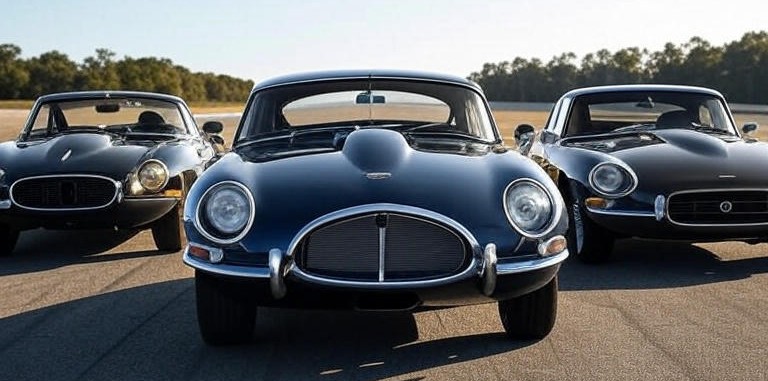
Series 1 (1961–1968)
- The original and most iconic version.
- Known for its covered headlights and pure design.
- Offered as a roadster, fixed-head coupe, and later a 2+2 version.
- Early 3.8-liter models are especially prized by collectors.
Series 2 (1968–1971)
- Updated to meet new safety and emission regulations.
- Open headlights (without covers).
- Improved cooling system and enhanced braking.
- Slightly revised interior for better ergonomics.
Series 3 (1971–1974)
- Introduced a powerful 5.3-liter V12 engine.
- Wider stance and flared wheel arches.
- Standard power steering and improved comfort features.
- More of a grand tourer than a pure lightweight sports car.
Each series reflected changing regulations and customer expectations, yet all retained the unmistakable E-Type DNA.
Why the Jaguar E-Type (1961) Is Still Admired
Collectibility
More than six decades after its debut, the Jaguar E-Type (1961) remains one of the most sought-after classic cars in the world. Early Series 1 models—especially the original 3.8-liter versions with covered headlights—are particularly valuable.
Collectors look for:
- Matching numbers (original engine and chassis pairing)
- Authentic factory specifications
- Original color combinations
- Documented ownership history
Well-preserved examples can sell for $200,000–$500,000 or more depending on rarity and condition. Limited-production variants and lightweight competition models command even higher prices.
Classic car auctions frequently showcase pristine E-Types as headline lots, proving that demand remains exceptionally strong. Restoration specialists around the world continue to dedicate years to bringing these cars back to factory condition.
The E-Type isn’t just collectible—it’s considered blue-chip automotive history.
Design Influence
The E-Type’s design continues to influence automotive styling decades later. Its proportions—long bonnet, short rear deck, low roofline—have become a blueprint for the ideal front-engine sports car.
Modern Jaguar models such as the Jaguar F-Type clearly echo the E-Type’s DNA. The flowing curves, muscular rear haunches, and driver-focused cabin layout all trace their inspiration back to 1961.
Even outside Jaguar, automotive designers frequently reference the E-Type as one of the most perfectly proportioned cars ever built. Its shape balances aggression and elegance in a way that feels natural rather than forced.
Unlike many classic cars that appear dated over time, the E-Type still looks contemporary. Its design transcends trends, making it a benchmark for beauty in industrial design.
Timeless Appeal
Perhaps the most powerful reason the Jaguar E-Type (1961) is still admired is its timeless character. It doesn’t rely on nostalgia alone—it genuinely holds up against modern sports cars in visual drama and emotional presence.
Its engineering was ahead of its time, with features like independent rear suspension and four-wheel disc brakes. But beyond the specifications, the E-Type delivers something modern cars often struggle to replicate: mechanical purity.
There are no driving modes, touchscreens, or digital distractions—just engine, steering, gearbox, and road. That simplicity creates an intimate driving experience that feels authentic and engaging.
Even in an era dominated by hybrid hypercars and electric supercars, the E-Type still turns heads wherever it goes. Park it beside contemporary machines, and it effortlessly commands attention.
Cars come and go, but icons endure. The Jaguar E-Type (1961) is one of those rare icons that continues to inspire admiration across generations.
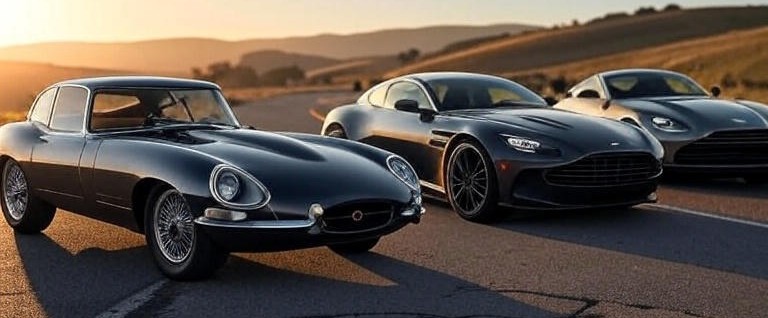
Jaguar E-Type (1961) vs Modern Sports Cars
The Jaguar E-Type was revolutionary in its era, but even today it holds its ground when compared to modern sports cars like the Porsche 911 and the Aston Martin DB11. While technology has evolved dramatically, many core elements of the E-Type still feel relevant.
Design –
The E-Type’s long bonnet, low stance, and flowing curves set a design template that modern sports cars still follow. The Porsche 911 maintains a timeless aerodynamic silhouette, while the Aston Martin DB11 reflects a similar balance of elegance and road presence. Even today, the E-Type looks strikingly modern.
Performance –
In 1961, reaching 0–60 mph in under 7 seconds was groundbreaking. Although modern cars are significantly faster, the E-Type delivered supercar-level performance for its time, making it one of the most exciting cars of the 1960s.
Driving Experience –
Unlike today’s sports cars that rely on advanced electronics and driver aids, the E-Type offers a raw, mechanical connection between driver and road. Many enthusiasts value this analog purity over modern digital precision.
Legacy Influence –
Its impact continues through models like the Jaguar F-Type, which carries forward the E-Type’s design DNA while integrating contemporary performance technology.
Ultimately, the Jaguar E-Type (1961) is not just a car of its time—it’s a timeless benchmark that continues to influence modern sports car design.
Fun Facts About the Jaguar E-Type
Here are some additional fascinating facts that highlight just how special the Jaguar E-Type truly was:
- The E-Type was initially priced at around £2,097 in the UK—significantly lower than many Italian rivals.
- Early 3.8-liter engines used a Moss gearbox, which required a deliberate shifting technique but added to the car’s character.
- The fixed-head coupe version offered surprisingly usable luggage space for a sports car.
- In 1996, the Museum of Modern Art (MoMA) in New York displayed the E-Type as part of its design collection, recognizing it as a work of art.
- Jaguar later produced a lightweight competition variant, further strengthening its racing credibility.
- Restoration projects for E-Types are among the most popular in the classic car world, with some taking years to complete due to the complexity of preserving originality.
- In recent years, Jaguar even introduced limited continuation models, showing how strong the demand and admiration remain.
These details only reinforce one truth: the Jaguar E-Type (1961) wasn’t just ahead of its time—it helped define its time.
Conclusion For Jaguar E-Type
The Jaguar E-Type (1961) wasn’t just a sports car—it was a revolution on wheels. With its blend of beauty, speed, and engineering genius, it gave the world a glimpse of what the future of motoring could look like. From its sleek curves inspired by aerodynamics to its advanced suspension and braking systems, the E-Type embodied progress in every sense.
It became more than just a mode of transport—it was a cultural icon. Rock stars, actors, and even royalty chose it as their car of choice. The Jaguar E-Type didn’t just represent luxury; it represented freedom, individuality, and daring to dream bigger. That’s why people lined up to own one, and why today collectors pay fortunes to add it to their garage.
But its greatest achievement might be its timeless appeal. Cars come and go, designs change, and technologies evolve, yet the Jaguar E-Type (1961) still looks breathtakingly modern. Few cars can claim that kind of staying power.
If you ever get the chance to see an Jaguar E-Type in person—whether at a car show, a museum, or cruising on the open road—pause for a moment. You’ll be looking at a piece of history that continues to inspire the future.
👉 Loved this deep dive into the Jaguar E-Type? Share this post with your fellow car enthusiasts, drop a comment about your favorite classic ride, and don’t forget to explore more of our automotive history blogs. After all, legends like the E-Type deserve to be remembered—and celebrated.
FAQs For Jaguar E-Type (1961)
1. Why is the Jaguar E-Type (1961) so famous?
Ans. The Jaguar E-Type became famous for its revolutionary design, advanced engineering, and relatively affordable pricing compared to rivals like Ferrari. It combined exotic-level performance with everyday usability. Even Enzo Ferrari reportedly called it “the most beautiful car ever made,” cementing its legendary reputation.
2. How fast was the Jaguar E-Type in 1961?
Ans. The original 3.8-liter inline-six engine produced about 265 horsepower, allowing a top speed of around 150 mph and 0–60 mph in under 7 seconds—exceptional performance for the early 1960s.
3. How much does a Jaguar E-Type (1961) cost today?
Ans. Values vary depending on condition, originality, and series. Early Series 1 models in excellent condition typically sell between $200,000 and $500,000, while rare or perfectly restored examples can exceed that range at major auctions.
4. What were the main versions of the Jaguar E-Type?
Ans. The E-Type was produced in three major series:
Series 1 (1961–1968) – Most desirable, especially early 3.8-liter models.
Series 2 (1968–1971) – Updated for safety and emissions regulations.
Series 3 (1971–1974) – Introduced a powerful 5.3-liter V12 engine.
5. What car replaced the Jaguar E-Type?
Ans. The E-Type was succeeded in 1975 by the Jaguar XJ-S (later called XJS). While successful in its own right, it never achieved the same iconic global status as the E-Type.
6. Is the Jaguar E-Type still roadworthy today?
Ans. Yes. Many restored E-Types are fully roadworthy and regularly driven at classic car rallies, concours events, and collector gatherings around the world.
7. Who designed the Jaguar E-Type?
Ans. The E-Type was designed by Malcolm Sayer, an aerodynamicist who previously worked on Jaguar’s Le Mans-winning race cars. His engineering-driven design approach gave the car its perfectly balanced proportions.
8. What engine options were available in the Jaguar E-Type?
Ans. The E-Type initially came with a 3.8-liter inline-six engine, later upgraded to a 4.2-liter inline-six. The Series 3 introduced a 5.3-liter V12 engine for smoother and more powerful performance.
9. Was the Jaguar E-Type successful in motorsport?
Ans. Although primarily designed as a road car, the E-Type had racing variants and participated in endurance events. However, it was Jaguar’s earlier D-Type race cars that achieved major Le Mans victories.
10. Why is the Series 1 Jaguar E-Type the most valuable?
Ans. Series 1 models—especially early “flat-floor” 3.8-liter versions with covered headlights—are highly collectible due to their purity of design and historical significance as the original release models.
11. How many Jaguar E-Types were produced?
Ans. Approximately 72,500 units were produced between 1961 and 1974, making it relatively attainable compared to some ultra-rare classic sports cars.
12. Does Jaguar still support the E-Type today?
Ans. Yes. Through Jaguar Classic, the company provides restoration services, authentic parts, and even limited continuation or electrified versions, ensuring the E-Type legacy continues.